
Greener Reefers in international maritime transport
Commissioned by: German Federal Ministry for the Environment, Nature Conservation, Nuclear Safety and Consumer Protection (BMUV)
Partner countries: Costa Rica and South Africa
Implementing partners: Costa Rica - Ministerio de Ambiente y Energía – MINAE (Ministry of Environment and Energy)
South Africa - Department of Forestry, Fisheries and the Environment (DFFE)
Duration: 04/2023 until 04/2026
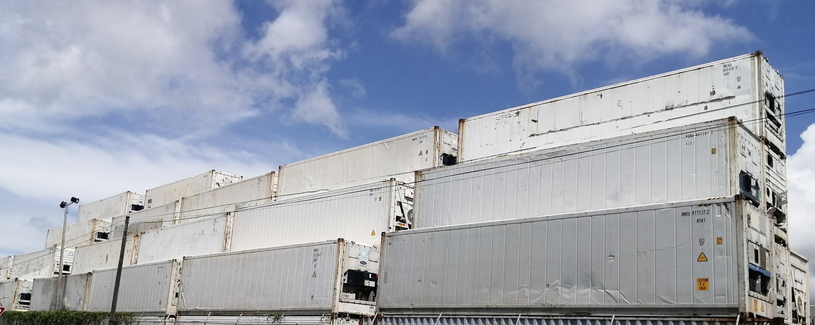
Maritime transport represents 80% of international trade of goods (UNCTAD 2021), and shipping is responsible for 3% of global Greenhouse Gas (GHG) emissions (IMO). Transporting valuable products through refrigerated containers, commonly known as reefers, is growing rapidly worldwide: Over 1.5 million refrigerated containers (reefers) are used for the international transport of chilled (e.g. fruit and medicines) and frozen products (e.g. meat and fish) across the oceans to billions of customers every day. The market share of reefer containers vs reefer ships has increased steadily to 80% and it is expected to keep increasing (see graphic below).
The current reefer fleet uses refrigerants with high global warming impact, toxic “forever chemicals” (per- and polyfluoroalkyl substances (PFAS) along with trifluoroacetic acid (TFA)) and have high energy demand. Majority of the GHGs are released due to leakages of the refrigerants (direct emissions) and the high energy demand increases the emissions by the vessels for the higher electricity production to keep the perishable goods chilled.
The use of natural refrigerants, better design and optimising operations have the potential to significantly reduce the climate and environmental impact of this fast-growing sector.
Objective
The project aims to facilitate a momentum to unite the private sector, international policies, and regulations in order to set a stage to ultimately make an effective difference. With the demonstration of a Greener Reefer, the shipping industry is able to establish and implement innovative eco-friendly technologies for reefers which are aligned and supporting the 2023 International Maritime Organisation's GHG emissions reduction strategy, the Paris Agreement’s objectives and the 2023 EU F-Gas regulation.
Greener Reefers are highly energy efficient refrigerated maritime containers that use natural refrigerants and blowing agents with ultra-low climate impact (GWP below 11) do not contain f-gases and PFAS.
Country specific objectives
Costa Rica is Central America’s largest exporter of chilled/frozen goods to Europe (1.45bn US-$ in 2020) and therefore is an excellent project partner country. The shipping route Puerto Moín, Costa Rica – Europe will provide optimal conditions for piloting Greener Reefer. Costa Rica has nationalized the ISO 20854 reefer norm on flammable refrigerants, which will serve as a valuable starting point for piloting reefers with natural refrigerants. Additionally, GIZ/Proklima as the implementing organisation will build on the successful cooperation with training centres in Costa Rica.
South Africa progressively updated their NDC in 2021 including a reference to their Green Transport Strategy and the recent carbon tax. As currently all reefers contain HFCs, this project partly contributes to South Africa’s compliance with the Kigali Amendment in future. Under the project it is foreseen to nationalize the ISO 20854 reefer norm on flammable refrigerants, which will provide the basis in South Africa to pilot climate friendly refrigerated containers with natural refrigerants. South Africa is Africa’s largest exporter of chilled/frozen goods to Europe (2,56bn US-$ in 2020) and therefore is an excellent project partner country. The shipping route South Africa – Europe will provide optimal conditions for piloting climate-friendly reefer containers.
Approach
The project encompasses several strategic measures aimed at innovating maritime transport practices to reduce environmental impact and promote eco-friendly solutions, including:
- Demonstrating the advantages of an environmentally and climate friendly R290 Greener Reefer pilot in collaboration with container manufactures, shipping lines and logistic operators.
- Developing technology roadmaps and forming alliances with the International Maritime Organization (IMO), the United Nations Framework Convention on Climate Change (UNFCCC), as well as partnering with port and maritime authorities along with transport ministries in respective countries for formulating emission mitigation strategies in the shipping industry.
- Developing training curricula and carrying out reefers trainings for trainers and technicians with refrigerant training centres in Costa Rica, South Africa and virtually.
- Establishing guidelines for an eco-label, similar to ISO standards, and creating a QCR Standard (Qualification, Certification, and Registration); and establishing methods to measure greenhouse gas emissions.